In this article
The fastest way to ruin an office refit is to repaint a meeting room on a Friday afternoon and expect staff back at their desks on Monday morning. Commercial paint needs time to cure, the right surface preparation, and a plan that works around people who still have a job to do. A reception wall scuffed grey within six months usually points to a cut-corner job rather than bad paint. This guide covers what actually matters when you refurbish a working Surrey office: meeting UK regulations, choosing a finish that survives daily wear, preparing surfaces properly, and keeping the business trading throughout. Ben & Roman handle commercial schemes of every size across Surrey and South West London, from a single floor to a whole-building strip-out.
Why a commercial repaint is not a domestic one
A spare bedroom takes almost any decent emulsion. An office does not. Corridors and reception walls absorb constant trolley knocks, shoulder rubs and chair backs; breakout areas get wiped down daily; and the whole building has to keep trading while you work. The job has to hit three targets at once: a finish tough enough to last, full compliance with health-and-safety law, and minimal disruption to the people using the space.
Cutting corners here is expensive. A contractor without proper risk assessments or VOC-compliant products can leave you exposed. Where things commonly go wrong:
- Standard trade emulsion fails early in high-traffic zones, so you end up repainting twice in the time a contract paint would have lasted once.
- The wrong products breach fire-safety or air-quality rules in an occupied building.
- A poorly planned schedule shuts down floors during working hours.
- Engaging an uninsured operative can invalidate your own cover and push liability back onto you.
The fix is straightforward: use insured commercial decorators who understand both the coatings and the legal side. Our commercial painting team works to documented method statements as standard.
1. Get the compliance right first
CDM 2015, COSHH and the VOC limits
Most office repaints sit below the threshold that needs formal notification, but the core duties still apply.
- CDM 2015. The Construction (Design and Management) Regulations require documented risk assessments and method statements (RAMS) even when the job is small. They set out who is responsible for what on site, and that includes you as the client.
- COSHH 2002. Products containing volatile organic compounds (VOCs) must be controlled and recorded. Under the UK regulations carried over from EU Directive 2004/42/EC, matt wall paints are capped at 30 g/litre of VOCs and most gloss and trim finishes at around 130 g/litre. There is more detail in our overview of commercial painting regulations in the UK.
Before work starts, ask any contractor for three things: their COSHH assessments, the product data sheets confirming VOC compliance, and proof of public liability insurance. Two million pounds of cover is a sensible minimum for commercial work.
One quiet trap: standard DIY paints often exceed commercial VOC limits and rarely have the wear resistance a busy office needs. They look like a saving and cost more over the lease.
2. Match the finish to each zone
One paint across the whole floor is a false economy. Different areas take different punishment, so a sensible scheme uses purpose-specific coatings:
| Area | Recommended Finish | Why |
| Reception & corridors | Durable satin or eggshell | Resists scuffs, easy to clean |
| Meeting rooms | Low-sheen matt | Reduces glare, hides wall imperfections |
| Breakout zones | Washable, low-VOC paint | Withstands frequent cleaning |
| Woodwork (doors, skirtings) | Hard-wearing gloss or semi-gloss | Long-lasting, professional look |
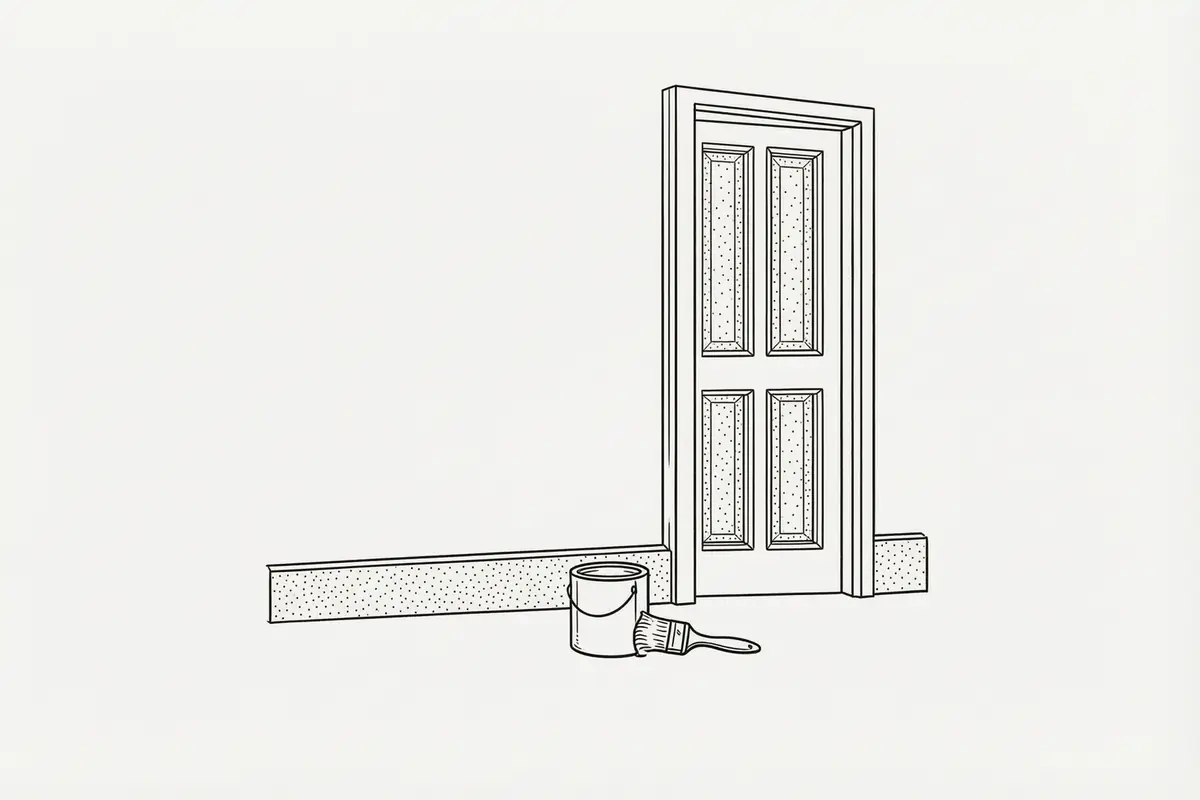
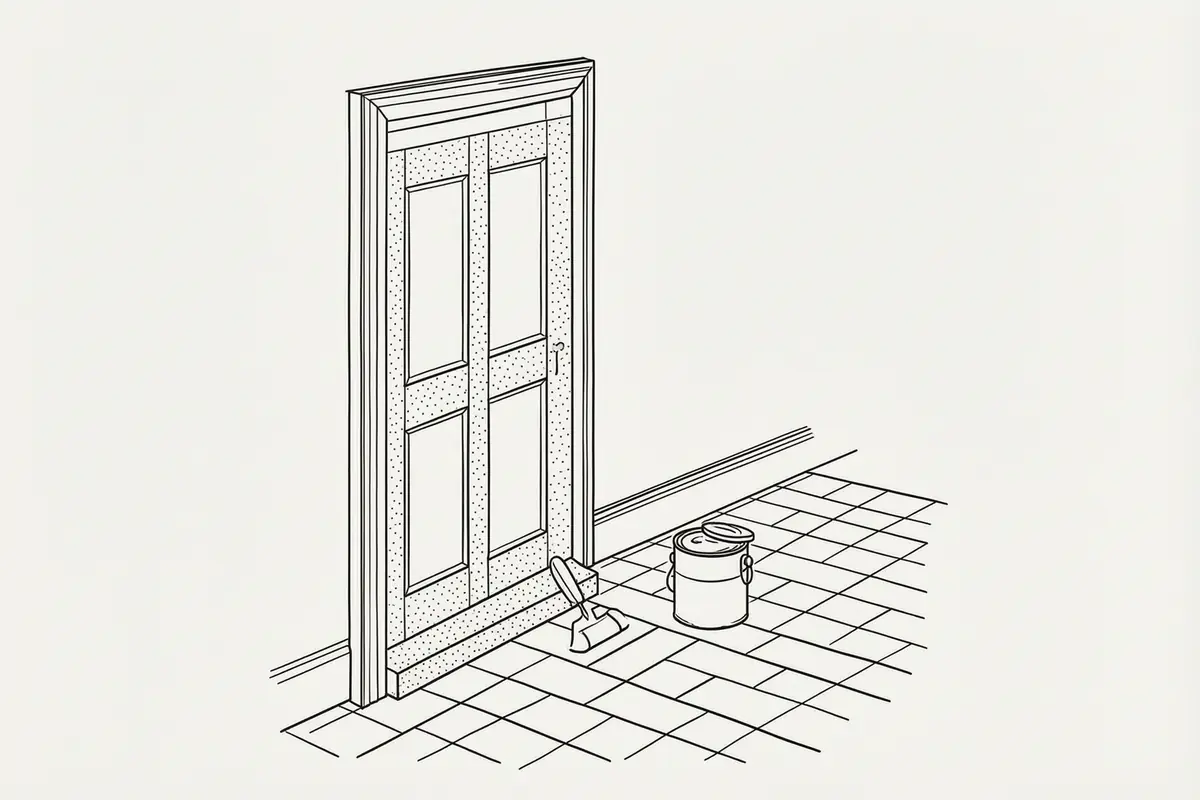
Woodwork needs particular care where doors, beams or skirtings were previously stained or varnished. As our write-up of interior woodwork spraying on a commercial property shows, painting over an unsealed stained surface invites adhesion failure, colour bleed and peeling. The cure is a stain-blocking primer and proper sanding before any topcoat goes on. For large door sets and runs of trim, spraying gives the flattest finish, which is why our office decorating team often works with spray equipment on site. If you are weighing painted walls against feature finishes, our comparison of wallpaper versus paint in commercial spaces is worth a look before you commit a budget.
3. Plan the work around the business
For most Surrey firms the biggest worry is not the paint, it is the downtime. Good commercial decorators build the schedule around your trading hours: working evenings and weekends, painting during holiday closures, or taking the building one floor at a time so the rest stays open.
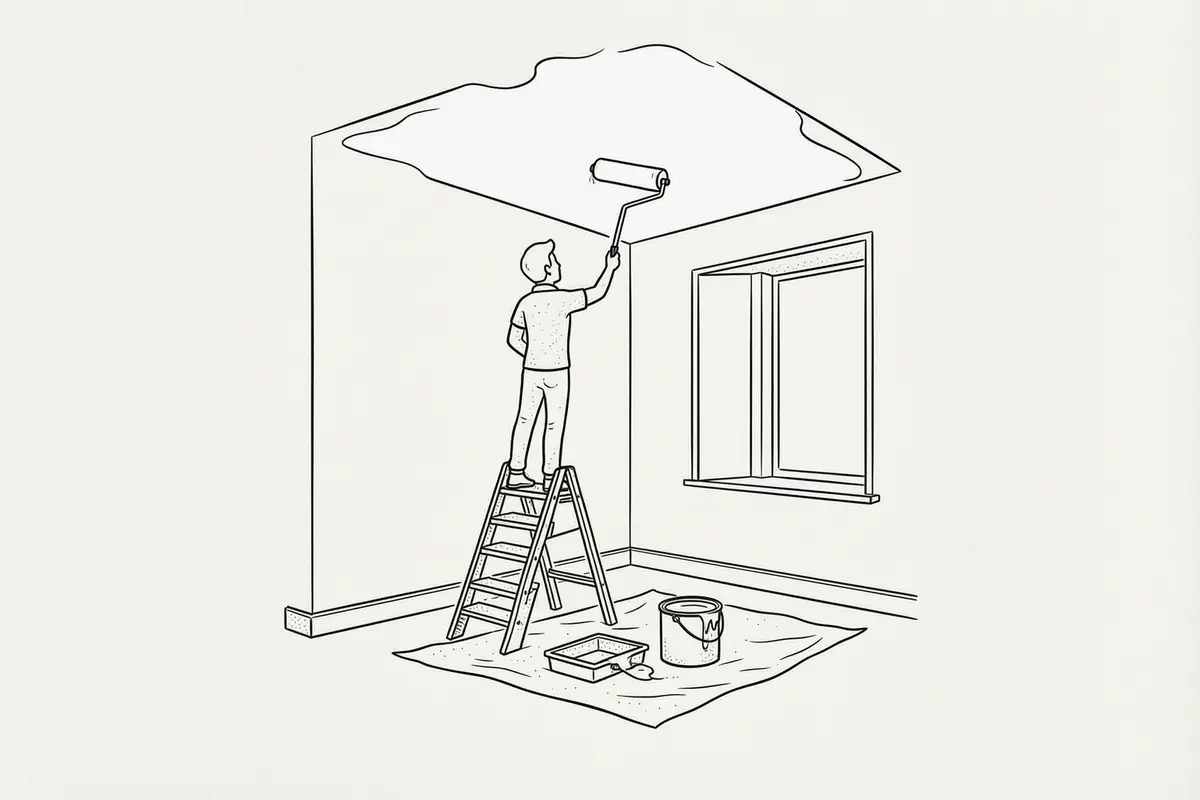
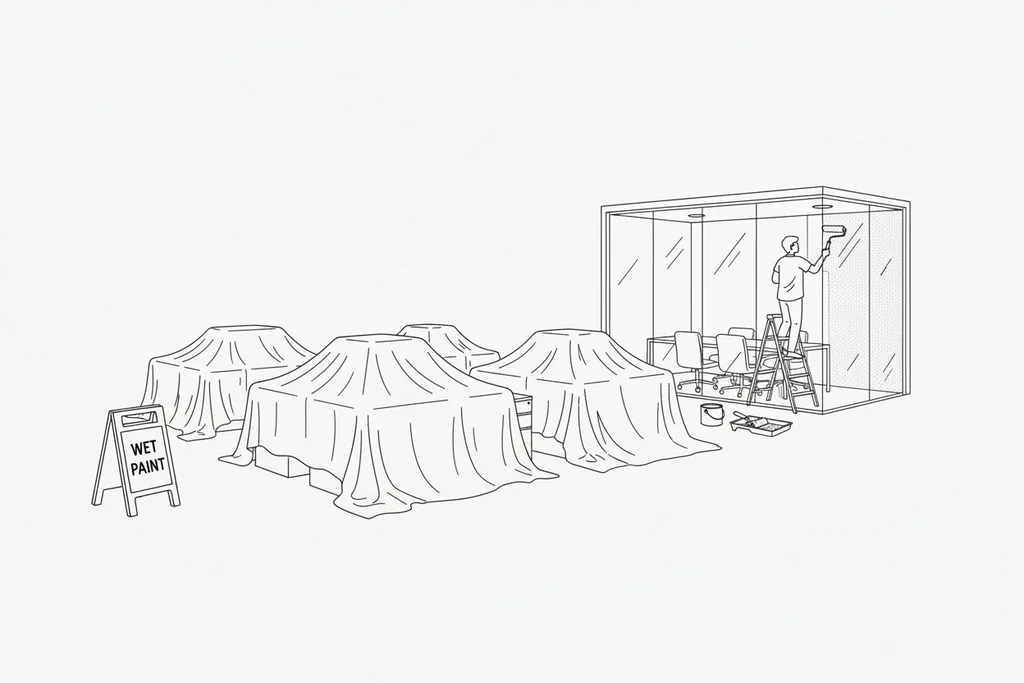
It is the same logic behind our notes on interior painting for an office revamp: protect everything, then phase the work so staff barely notice it. The steps that keep an occupied site safe and moving:
- A pre-project walkthrough to map access routes, fire exits and hazards.
- Dust sheeting and protective film over desks, equipment and flooring.
- Clear wet-paint and restricted-area signage.
- HEPA-filtered extraction to manage fumes and dust where people are still working nearby.
This is not just courtesy. It is how you meet the duty under the Health and Safety at Work etc. Act 1974 to keep non-workers safe on a live site.
4. Do not skip surface preparation
Preparation is the single biggest predictor of how long a commercial scheme lasts, and it is the first thing a cheap quote cuts. Office walls carry a particular set of marks:
- Whiteboard marker ghosting and dry-wipe residue.
- Poster and tape adhesive left behind on plaster.
- Grease build-up around kitchen and breakout areas.
- Impact damage from trolleys, chairs and desk corners.
A proper sequence degreases every surface with an industrial cleaner, fills and caulks the dents and cracks, then sands back to a flat, sound base. Stubborn stains such as nicotine, water marks and ink need a dedicated stain-blocking primer, or they bleed straight through the new colour. Older Surrey offices with solid plaster walls should be primed with a breathable, mineral-based product so trapped moisture can escape rather than pushing the paint off the wall.
5. Choose a qualified, insured contractor
Price should never be the only deciding factor on a commercial job. Before you appoint anyone, check they hold:
- Public and employer's liability insurance.
- Recognised accreditations such as CHAS, Constructionline or PDA membership.
- Genuine experience working in occupied commercial environments, not just domestic.
Under the 1974 Act, a client who knowingly engages unsafe operatives shares responsibility for what happens on site, so hiring properly is risk management as much as quality control. We supply full RAMS documentation and low-VOC, commercial-grade products on every project, so the finish looks right and the paperwork stands up.
What Surrey offices are asking for in 2026
Three requests come up repeatedly: biophilic schemes in earthy, muted tones that make the most of natural light; micro-textured paints that take a little edge off echo in open-plan rooms; and antimicrobial coatings for shared kitchens, washrooms and healthcare-adjacent spaces. Trends move, but the fundamentals do not. Whatever finish is in fashion, the result still depends on honest preparation and a contractor who follows the rules.
Getting it right the first time
A commercial office refurbishment in Surrey is a planning exercise as much as a colour choice. Get the compliance, the finishes, the prep and the schedule right and you repaint once, not twice. Whether you are freshening a single meeting room in Guildford or repainting a warehouse office near Epsom, the same discipline applies.
If you would like an honest assessment of your space and a free, no-obligation quote, get in touch with Ben & Roman and we will talk through the options.