In this article

A landlord books a quick repaint of a Guildford office over a weekend, the chosen decorator turns up without method statements or proof of insurance, and a contractor slips off a wobbly ladder in the stairwell. Suddenly the building owner is fielding questions from the Health and Safety Executive and discovering that the policy he assumed would cover it does not.
Commercial painting carries duties that a spare-bedroom refresh never does: more people on site, members of the public passing wet edges, working at height, waste to dispose of correctly, and a legal framework that holds the client partly responsible for the contractor they hire. This guide sets out the regulations that actually apply, when they bite, and the short list of documents to ask for before work starts.
Why Compliance Matters in Commercial Painting
The two big risk areas in any decorating job are falls from height and exposure to hazardous substances, and both feature heavily in HSE construction enforcement. Get them wrong on a commercial site and the consequences are not just paperwork: stop notices that freeze your refurbishment, fines, and an insurer that walks away from a claim because the work was carried out unsafely.
The rules are not mysterious, though. Most of what follows comes down to three pieces of legislation, sensible site management, and keeping a paper trail, which a decorator who works in commercial settings handles as routine, the same way we do across office refurbishments in Surrey.
Key UK Regulations That Apply to Commercial Painting
Construction (Design and Management) Regulations 2015 (CDM 2015)
CDM 2015 applies to construction work, and a substantial repaint that involves scaffolding, structural changes or a wider fit-out alongside the painting usually counts. Formal notification to the HSE is only required where a project runs over 30 working days with more than 20 workers on site at once, or exceeds 500 person-days.
Most office and shop repaints sit well below that threshold and need no notification. CDM duties still apply, though: there must be sensible planning, and the contractor should produce risk assessments and method statements (RAMS) before lifting a brush. Treat a decorator who cannot supply RAMS as a warning sign.
Control of Substances Hazardous to Health (COSHH) 2002
Paints, primers, solvents and strippers can release volatile organic compounds (VOCs) and other hazardous substances. COSHH requires an employer to:
- Assess the risk from each product before it is used on site
- Control exposure, typically through ventilation, extraction or respiratory protection (RPE)
- Store and dispose of materials and washings safely, never down a drain
Separately, the VOC content of decorative paints is capped by regulations carried over from EU Directive 2004/42/EC. Two limits worth knowing: matt wall and ceiling paints are restricted to 30 grams of VOC per litre, and high-gloss paints to 130 grams per litre. Reputable trade ranges are formulated to meet these, and low-VOC products are the sensible default for occupied buildings where people are still working nearby.
Health and Safety at Work etc. Act 1974 (HSWA)
The HSWA is the backbone. It places a duty on employers to protect not only their own staff but anyone affected by the work: your customers, your employees, visitors and passers-by. On a live commercial site that translates into a few practical, non-negotiable basics:
- Clear signage for wet paint, and barriers or tape around restricted zones and freshly coated edges.
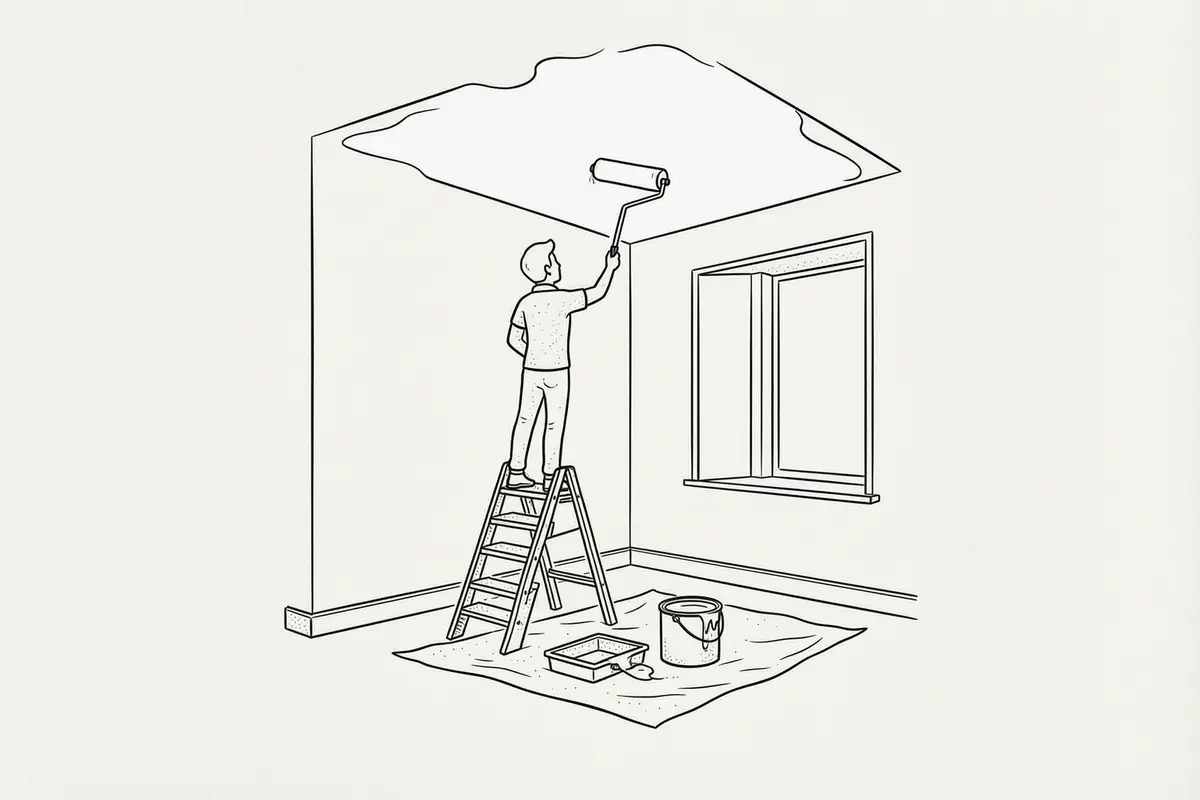
- Safe access at height, meaning correctly assembled tower scaffolds and footed, inspected ladders rather than whatever is to hand.
- Trained operatives in the right protective equipment for the products in use.
Skip these and you are not only exposing people to harm, you are handing your insurer a reason to void cover if something goes wrong.
Practical Steps for Surrey Businesses
1. Hire a qualified, insured contractor
Before you accept a quote, check that the decorator carries:
- Public liability insurance (£5 million cover is common for commercial work; never accept less than £2 million)
- Employer's liability insurance if they have employees, which is a legal requirement
- Relevant accreditations such as CHAS or Constructionline, or membership of the Painting and Decorating Association
This matters because of how the HSWA treats the client. If you knowingly engage an unsafe or uninsured operative, you share the liability when it goes wrong. Our commercial painting team works fully insured and to documented RAMS, so the paper trail is sorted before anyone arrives on site.
2. Plan the work around your operating hours
Most commercial jobs are scheduled for evenings, weekends or holiday closures so trade can carry on. Whoever you appoint should be comfortable working out of hours and around your fire-safety routes, alarm systems and access control, rather than expecting you to shut up shop. Phased working, finishing one floor or one zone before moving to the next, keeps disruption to a minimum. For an occupied office repaint that planning is half the job, as our write-up on an office revamp shows.
3. Ask for the documentation
A professional firm hands these over without being chased:
- COSHH assessments for the products being used
- A site-specific risk assessment and method statement (RAMS) for your building
- Product data sheets confirming VOC compliance
The paperwork is not box-ticking for its own sake. It is the clearest signal that a contractor understands their legal duties and has thought about your premises before turning up.
Common Pitfalls to Avoid
- Assuming a small job is exempt. Even a single shop unit needs basic risk assessment, signage and safe access. Scale changes the paperwork, not the duty of care.
- Using DIY paint in commercial settings. Consumer products can exceed the VOC limits for the way they are applied and rarely stand up to the scuffing and washing of a high-traffic space. The same logic applies when weighing up wallpaper against paint in commercial spaces.
- Not vetting the contractor. Skipping insurance and accreditation checks leaves you carrying the can for injuries or sub-standard work, and possibly an unpaid HSE bill.
If your project involves more than walls, the same compliance logic carries over to specialist work such as spray-finishing interior woodwork, where overspray, masking and ventilation all need managing on a live site.
The Short Version
Compliant commercial painting comes down to three things: the right legislation understood, the site managed safely, and the documents in a folder before work begins. Handle those and the job protects your people, your premises and your insurance cover.
If you would rather not wade through it, that is what we are here for. For a free quote on a compliant office, retail or warehouse repaint anywhere in Surrey or South West London, get in touch with our team or call 01483 694110.