In this article

Your front door takes more punishment than almost any other painted surface on the house. It faces driving rain off the North Downs, bakes in afternoon sun, gets slammed a dozen times a day and is the first thing anyone sees when they arrive. So the question of the best paint for front doors is not really about colour first (though we will get to that) — it is about picking a coating tough enough to survive a Surrey winter and still look smart the following summer. In our experience, most tired, flaking front doors are not the fault of the door at all; they are the fault of the wrong paint, or the right paint applied over poor preparation.
In this guide our painters walk you through what actually matters when choosing exterior door paint — the finish, the surface you are painting onto, and the prep that makes or breaks the job — then round up five products we would happily use ourselves.
Some links in this article go to Amazon. As an Amazon Associate we earn from qualifying purchases — it costs you nothing and helps keep guides like this free.
What to look for in a front door paint
The single most important thing is that the paint is genuinely exterior-grade. Interior door paint or standard trim paint will not cope with UV and moisture; within a season you will see it dull, chalk and lift. Look on the tin for wording like "exterior wood and metal", "weatherproof" or a stated years-of-protection figure. Beyond that, we weigh up three things:
- Weather resistance — a flexible film that moves with the timber as it swells and shrinks, rather than a brittle one that cracks and lets water in behind it. Microporous formulas are worth seeking out on timber: they let moisture vapour breathe out instead of blistering the film off from behind.
- Water-based versus oil-based — modern water-based (acrylic) exterior paints stay flexible, keep their colour, and are touch dry in one to two hours and recoatable in four to six — against sixteen to twenty-four hours for solvent gloss. Oil gloss still gives a lovely deep shine, but it yellows on north-facing doors and turns a one-day door into a three-day job.
- Self-priming or "2-in-1" — many door paints now combine primer, undercoat and topcoat. These save real time on sound, previously painted doors, but bare or patchy timber still does better with a dedicated primer first.
On quantity: a front door is about 2 square metres per face, and most exterior satins cover 12 to 16 square metres per litre, so one 750ml tin does two coats on both faces with plenty left for touch-ups.
If you are unsure whether your door counts as "bare" or "sound", it is worth reading up on the difference between the two products before you buy — our guide on undercoat versus primer explains when each is needed and why skipping the primer on bare wood is a false economy.
Satin, gloss or matt — which finish?
Finish is where taste and practicality meet. For front doors we recommend one of three, and in a fairly clear order of preference:
- Satin is our default choice for most Surrey homes. Sitting at roughly 30 to 40 per cent sheen, it has enough shine to shed water and wipe clean, but it is forgiving — it hides small imperfections and brush marks far better than gloss, and it suits both period and modern properties. It is also the easiest finish for a DIYer to get right.
- Gloss (up around 85 to 95 per cent sheen) gives the traditional, high-shine "Farrow-and-Ball" front-door look and is superb on a well-prepared panelled Victorian or Georgian door. The catch is that gloss magnifies every ripple, run and speck of dust, so it demands a proper undercoat, a 240-grit denib before the final coat, and a still, dust-free day.
- Matt and eggshell (under 10 and roughly 10 to 25 per cent sheen) have become fashionable, particularly in heritage greys and greens. They look wonderful on the day, but a dead-flat finish on a south-facing door is harder to keep clean and, on cheaper paints, less weatherproof. Choose a matt specifically rated for exterior doors.
Does the door material change the paint?
Yes, more than most people expect. The three we are asked about most in Surrey are timber, composite and uPVC, and each behaves differently.
Timber doors
Solid and engineered timber doors are the most paint-friendly and, happily, the ones our chosen products are made for. Bare wood needs a primer; previously painted wood needs a clean, a light sand with 120-grit and a good exterior topcoat. The exceptions are oily hardwoods — iroko and teak reject standard primers, so degrease with methylated spirits and use an aluminium wood primer — and knotty softwood, which needs shellac knotting solution on every knot before priming or the resin will bleed amber rings through your topcoat within months. Timber is also the surface where finish quality really shows, which is why we take the same care with a door as we do with our wooden window painting work.
Composite doors
Modern composite doors come pre-finished and, strictly, do not need painting. But the colour does fade over ten to fifteen years, and plenty of homeowners want to change it. Composites can be repainted, but only with the right adhesion primer and a flexible exterior topcoat — skip that and the paint will peel off the smooth GRP skin in sheets. Degrease thoroughly, dull the sheen with a fine abrasive pad (never coarse sandpaper), then apply thin coats with a short-pile roller. Composites are also the doors we most often spray rather than brush — a sprayed coat sits beautifully flat on that glassy skin. If your door is under warranty, check first, as painting can void it.
uPVC doors
uPVC is the trickiest. It is non-porous and slightly flexible, so it needs a dedicated uPVC primer (or a paint sold specifically for plastic) and scrupulous cleaning and keying beforehand — solvent cleaner to strip hand grease, then a grey abrasive pad to take the shine off. And think twice before painting white uPVC a very dark colour on a south-facing elevation: dark films absorb heat, and a plastic door under near-black paint can expand enough to stick in its frame on a hot day. It can be done and it can look excellent, but it is unforgiving of shortcuts. If you are painting over an existing glossy finish of any kind, our guide on how to paint over gloss covers the keying and de-greasing that stops the new coat sliding off.
Getting the prep right
We say it constantly because it is true: preparation is ninety per cent of a door that still looks good in five years. Two thin coats always beat one thick one — thick coats sag on panel mouldings, take longer to cure and trap moisture. Our piece on how many coats of paint you actually need covers how coats build up; here is the exact routine our painters follow on a typical timber repaint.
How we paint a front door, step by step
- Start mid-morning. A front door has to close again at night. With a water-based satin recoating in four to six hours, starting by 9.30am gets the second coat on by mid-afternoon and touch dry before the evening damp. Oil gloss is a two-day job: one coat per day.
- Take the furniture off. Letterplate, knocker, handle, numerals — ten minutes with a screwdriver beats an hour of fiddly cutting-in.
- Wash the whole door. Sugar soap and a sponge, rinse with clean water, let it dry. Grease around the handle and letterplate is the top reason paint refuses to stick.
- Sand to a sound, dull surface. 80-grit on flaking areas until every loose edge is gone, 120-grit to feather the edges and scuff sound gloss, then 180-grit over the whole door — always with the grain.
- Fill and spot-prime. Two-part exterior wood filler in dents and open joints (it sets in twenty minutes and sands crisp), then spot-prime bare timber — including the top and bottom edges, whose unsealed end grain is why so many doors blister from the bottom rail up.
- Dust off properly. Brush down, vacuum the rebates, wipe with a tack cloth. Dust is the enemy of a smooth finish, especially gloss.
- Paint in the right order. Mouldings first, then the panels, the centre verticals, the horizontal rails, the outer stiles, and finally the edges. We use a 2-inch (50mm) angled synthetic brush for water-based paint; on the flats a 4-inch short-pile roller lays it on evenly, laid off straight away with the brush, following the grain.
- Second coat after the recoat window. Denib with 240-grit once the first coat is hard, dust, recoat. Do not go back over areas already tacking up — that is how drag marks happen.
- Rehang the furniture and close up gently. Refit hardware the next morning. Water-based paint feels dry in hours but hardens over days, so close the door softly on the first night — a weatherseal will bond to a soft film and tear it.
Timing it around the Surrey weather
Exterior painting is a fair-weather job. Most water-based door paints want at least 8 to 10°C — 10 to 20°C is the sweet spot — and, crucially, no rain and no heavy dew for four to six hours after the final coat. Humidity matters as much: above about 80 per cent, curing slows right down and water-based finishes can dry with a milky bloom. In practice that means late spring through early autumn for us, starting mid-morning once any overnight damp has burned off — not so late that the fresh film is still soft when the evening moisture rolls in off the clay soils. Avoid blazing direct sun too; on a hot sun-struck door the paint skins before it has levelled, dragging under the brush. A still, dry, mild day is worth waiting for.
The best front door paints we would actually use
With all that in mind, here are five exterior paints that earn their place on a Surrey front door. All are readily available, and between them they cover classic white, on-trend darks and heritage colour.
Johnstone's Quick Dry Satin, Brilliant White
This is a sensible, no-drama choice and our pick for anyone who wants a clean brilliant-white door without fuss. It is a water-based satin for exterior wood and metal, so it dries quickly, keeps its colour and lets you get two coats on in a single day. Johnstone's quote around six years of protection and 12 square metres of coverage per litre, which is plenty for a standard door with change to spare. For the money, it is hard to beat as an everyday exterior door paint.

Johnstone's - Quick Dry Satin - Brilliant White- Satin Finish - Exterior Wood & Metal - Resistant to cracking & peeling - 6 years of life - 12m2 Coverage per Litre -750 ml (Pack of 1)
£11.99 — Amazon price when we checked (July 2026); see the listing for today's price
View on Amazon →Ronseal 10 Year Weatherproof 2-in-1, Black Satin
A black front door remains one of the smartest looks on a Surrey street, and this Ronseal is the one we reach for when a client wants it. The "2-in-1" means primer and topcoat in the same tin, so on a sound existing door you can skip the separate undercoat. Ronseal rate it for ten years of weatherproofing, and the satin black holds its depth without the yellowing you would get from a traditional oil gloss. It is genuinely a paint-and-go product for previously painted timber.

Ronseal 10 Year Weatherproof 2 in 1 Wood Paint Black Satin 750ml
£17.45 — Amazon price when we checked (July 2026); see the listing for today's price
View on Amazon →Ronseal 10 Year Weatherproof 2-in-1, Grey Satin
The same trusted 2-in-1 formula in the grey that has taken over so many front doors and window frames over the last few years. If you want your door to tie in with anthracite or slate-grey windows — very common on newer Surrey builds and extensions — this is an easy match. It shares the ten-year weatherproof rating and the forgiving satin sheen, so it is a strong choice for a coordinated, modern frontage that will not date quickly.
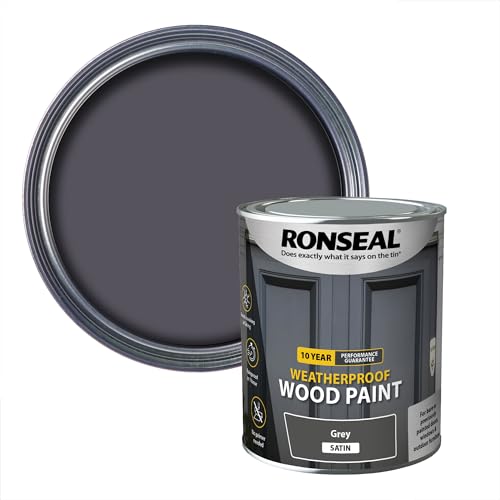
RONSEAL 10 Year Weatherproof 2-in-1 Wood Paint Grey Satin 750ml
£15.99 — Amazon price when we checked (July 2026); see the listing for today's price
View on Amazon →Johnstone's Quick Dry Satin, Natural Sage
Heritage greens are having a real moment, and this natural sage is a lovely, muted example that suits period cottages and red-brick terraces alike. It is the same quick-drying, water-based exterior satin as the brilliant white above, with the same six-year protection and generous coverage, just in a softer colour. If you want your door to stand out gently rather than shout, sage over a crisp white surround is a combination we are asked for more and more.

Johnstone's - Quick Dry Satin Natural Sage Finish Exterior Wood & Metal Resistant to cracking peeling 6 years of life 12m2 Coverage per Litre 750 ml (Pack 1)
£15.82 — Amazon price when we checked (July 2026); see the listing for today's price
View on Amazon →THE ONE All-In-One Paint and Primer, Black Matt
For anyone chasing the fashionable dead-flat matt look, this all-in-one is worth a look. It bundles paint and primer, is water-based and low-VOC, and is rated for both indoor and outdoor use across a range of surfaces — handy if you also want to touch up furniture or garden woodwork with the same tin. Bear in mind it comes in a smaller 250ml size, so it suits a single door or a test area rather than a big job, and a matt finish on an exposed south-facing door will want keeping clean. As a one-coat matt, though, it is a neat, modern option.

THE ONE All-In-One Paint & Primer - Black Matt, 250 ml | Multi-Surface 1 Coat Formula | Easy Indoor & Outdoor Decorating for Home & Garden Walls, Floors & Furniture | Durable, Water-Based & Low VOC
£14.95 — Amazon price when we checked (July 2026); see the listing for today's price
View on Amazon →Choosing the right colour
A quick word on colour, since it is the part everyone enjoys. Match the door to the house rather than to a trend: dark blues, blacks and heritage greens flatter red brick and render; softer greys and sage suit painted or rendered frontages; and a classic gloss white or black never looks wrong on a period property. Consider the aspect too — very dark colours on a door in full sun get noticeably hot and can move the timber more, so prep and a flexible topcoat matter even more. If you are torn between shades, paint sample boards and prop them by the door for a few days — colour reads differently at 9am and 6pm. And whatever you pick, buy a little extra; a stored touch-up tin is the cheapest way to keep the door looking cared for between full repaints.
Common mistakes we get called in to fix
A good share of our door work is putting right jobs that failed early, and the same avoidable mistakes come up again and again:
- Painting over flaking paint. New paint is only as well-attached as what is underneath it; brushed over loose edges, the whole lot lifts together within the first winter. Loose paint has to come off first.
- One thick coat instead of two thin ones. A heavy coat sags around mouldings, wrinkles as it cures and stays soft for days.
- Ignoring the top and bottom edges. Unsealed end grain wicks moisture into the door, which blows the paint off the face from behind and makes the door swell and stick every winter.
- Painting too late in the day. Dew on a soft film flattens the sheen and leaves milky patches. If the second coat is not on by mid-afternoon, wait until tomorrow.
- The wrong product on plastic. Standard wood gloss straight onto uPVC or composite peels off in sheets within a year. Plastic needs an adhesion primer or a paint made for the job.
- Closing the door on soft paint. Weatherseals bond to a fresh film and tear strips out when the door reopens. Leave it ajar until touch dry.
When to call in a professional
A sound, previously painted door is a realistic weekend job for a careful DIYer. It stops being a fair fight when the old paint has failed down to bare wood in several layers (a full strip with a heat gun or chemical stripper before any painting starts); when the house is pre-1960s and older layers may contain lead — never dry-sand those; when there is soft or rotten timber in the bottom rail that needs splicing before paint will hold; or when a faded composite wants spraying rather than brushing. Decorator day rates in the UK typically run £150 to £250, and a front door is usually a half-day to a full day depending on condition — our guide to painter and decorator prices breaks down what drives the quote.
Our verdict
If we had to sum it up: choose an exterior-grade, water-based satin for the best balance of looks and longevity; prime bare or plastic surfaces properly; and paint on a dry, mild day. Get those three right and any of the paints above will give you a front door that shrugs off a few Surrey winters. Of course, a front door is also the easiest place to see a shaky brush hand, and it is often part of a bigger exterior job. If you would rather it were done once and done properly, our exterior painting team handles doors, windows and full house exteriors across the county — and if you want a broader steer on products for the whole outside of the house, our guide to the best exterior paint for Surrey homes is the natural next read. When you are ready, get in touch for a free, no-pressure quote and we will talk you through the options for your door.
Frequently asked questions
Can you paint a uPVC front door?
Yes, a uPVC front door can be painted, but only with the right preparation and product. Degrease with a solvent cleaner, key every surface with a fine abrasive pad, then use a dedicated uPVC primer or a multi-surface paint rated for plastic. Ordinary wood paint on unprepared plastic peels within months, and very dark colours on a sun-facing white door can make it distort and stick.
Can you paint a composite front door?
Yes, composite doors can be repainted once the factory colour fades, typically after ten to fifteen years. Degrease the GRP skin, dull the sheen with a fine abrasive pad, then apply an adhesion primer and two thin coats of a flexible exterior paint. Check the door's warranty first, as repainting can void it; a sprayed finish sits flattest on the smooth skin.
How much does it cost to paint a front door?
Doing it yourself costs roughly £25 to £50 in paint, abrasives and sundries, since one 750ml tin covers a door twice over. A decorator typically charges around £100 to £250: a sound door is a half-day repaint, while stripping failed layers pushes it towards a full day at typical UK day rates of £150 to £250.
How do you paint a wooden front door?
Remove the door furniture, wash with sugar soap, then sand to a sound, dull surface — 80-grit on flaking areas, 120-grit overall, finishing with 180. Fill dents, spot-prime bare timber and dust off. Apply two thin coats of exterior satin or gloss with a 2-inch angled brush, mouldings and panels first, edges last, with a light 240-grit denib between coats.
Satin or gloss for a front door?
Satin is the better choice for most front doors: it sheds water, wipes clean and hides brush marks and small dents far better than gloss. Gloss gives the traditional high-shine look and rewards a well-prepared period door, but it magnifies every flaw, and traditional oil-based gloss slowly yellows, most visibly on north-facing doors.
When is the best weather to paint a front door?
A dry, still, mild day between 10 and 20°C is ideal, with no rain or heavy dew for four to six hours after the final coat. Start mid-morning once overnight moisture has burned off, and never paint in direct hot sun, which skins the film before it levels. In Surrey that realistically means late spring to early autumn.
Product prices and availability shown were correct when checked in July 2026 and may have changed. Certain content that appears on this site comes from Amazon. This content is provided "as is" and is subject to change or removal at any time.